
September delivered a soft jobs report, a hotter CPI print, and firm PMIs on both sides of the Atlantic. Inside: why quality matters more in credit, what to expect from Q3 earnings, and the case for active fixed income.
September Jobs Report Disappoints as CPI and Wholesale Inflation Climb
Nonfarm payrolls rose by just 29,000 in September, well below the 84,000 forecast. The unemployment rate increased to 4.2%, though largely due to an influx of members in the labor force. In addition to the weakness in September, the August jobs count was revised lower to reflect a gain of 133,000 while July switched from a gain to a loss as payrolls fell by 10,000. Average hourly earnings increased just 0.1% in September, putting the 12-month gain at 3.0%, the lowest since May 2021. Most of the monthly job gains came from healthcare, which added 17,000 workers. Construction was up by 11,000, and manufacturing added 9,000. Government employment fell by 17,000.
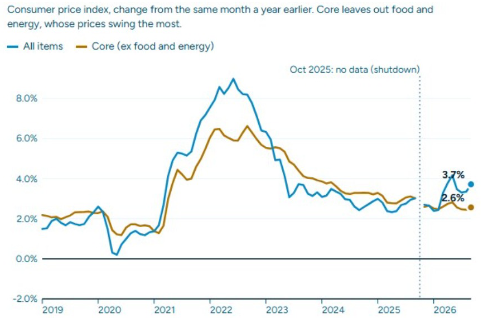
The September inflation report came in a bit hotter than expected with headline CPI rising by 0.6% month-over-month (M/M) or 3.7% year-over-year (Y/Y). Core CPI increased 0.3% M/M or 2.6% Y/Y. Both figures were up from 3.4% and 2.4%, respectively, in August. Most of the inflation increase last month relates to the geopolitical issues and corresponding surge in energy prices. While food inflation was flat M/M, one concerning data point was the 0.4% increase in shelter costs which have been relatively tame for the past few months. This could signal another uptick in core inflation that would likely force the Fed into a more hawkish monetary policy response. Wholesale prices surged 6.3% Y/Y in September.
Source: U.S. Bureau of Labor Statistics
U.S. Activity Holds Firm as Eurozone PMI Hits a 41-Month High
The manufacturing sector in the U.S. exhibited flat month-over-month activity based on the latest ISM Manufacturing PMI. The headline reading of 54.5 for September was down from 54.6 in August with strength coming from new orders, employment and prices. The production component fell in September, albeit from strong initial levels. The ISM Services PMI fell from 55.4 in August to 54.9 in September with weakness in new orders and production. Retail sales increased 0.8% in September, well ahead of estimates.
The eurozone composite PMI hit a 41-month high of 53.1 in September, up from 52.0 in August. Output rose at the fastest pace since April 2023 amid solid expansions in both the services and manufacturing sectors. The latest rise in output was also broad-based across different geographies. Germany posted an expansion for the third month running, with the rate of growth the fastest in just under a year. Activity increased in France for the first time in ten months, although future growth is at risk due to widespread unrest. The rest of the eurozone registered a solid but softer rise in output. Accelerating business growth means the flash PMI survey is indicative of GDP rising at a quarterly rate of 0.4%, with order book growth picking up further momentum across both manufacturing and services in September to hint at sustained momentum heading into Q4.
China’s PMIs Return to Expansion, but Domestic Demand Lags
The RatingDog China Services PMI rose to 51.6 in September from 51.4 in August, staying above the 50-mark that separates growth from contraction. New business grew at its quickest rate since June, supported by improving demand, while new export orders rose at a faster clip than in August. The employment gauge rose for a fifth straight month, and input costs eased a bit from the prior month. The non-manufacturing PMI also returned to expansionary territory in September, climbing to 50.2. China’s official manufacturing PMI rose to 50.1 in September from 49.8 in August. The modest expansion was driven by accelerated activity in equipment and high-tech-related manufacturing and consumer industries. Manufacturers have benefited from the AI boom, but domestic demand remains weak.
Why Higher-for-Longer Rates Call for Higher-Quality Bonds
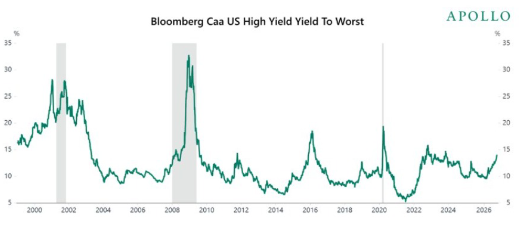
Higher for longer is a slow squeeze for low-quality credit. Every month rates stay elevated, more CCC borrowers from the 2021–2022 vintages hit the refinancing wall with less cash to service their debt. With CCC yields around 15%, the bill from the cheap-money era is landing on the weakest balance sheets first. The pain is sharpest in heavily levered, PE-backed technology, healthcare and consumer discretionary names, where floating-rate debt, thin margins, and AI disruption risk leave little room to absorb years of elevated borrowing costs. Strong balance sheets locked in cheap fixed-rate debt and have barely felt the Fed’s tightening, while the most leveraged borrowers feel it in full as floating-rate costs and maturities reset. The message is to move up in quality and to invest in companies with earnings that can pay their higher debt-servicing costs. We see no need to reach for yield in CCC names, given attractive yields in higher rated issuers.
Source: Bloomberg, Macrobond, Apollo
Q3 2026 Earnings Preview: Energy and Tech Expected to Lead Again
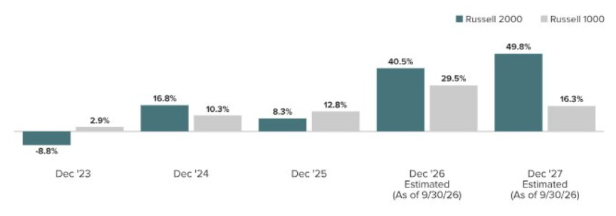
As we enter the Q3 earnings season, investors will be looking for additional growth/spending color on the AI thematic trade and the underlying hyper-scalers. The analyst community expects around 30% Y/Y earnings growth in Q3, the third straight quarter of more than 25% EPS growth. Energy, tech, and communication services are projected to report the highest Y/Y EPS growth in Q3 with financials and consumer staples bringing up the rear at around 3% growth. Analysts expect 32.7% earnings growth for calendar year 2026 and 15.8% for 2027, which should be another year driven by tech earnings. It is important to note that the small cap Russell 2000 Index is forecast to report 40.5% EPS growth for 2026 and 49.8% for 2027.
Source: Bloomberg, Macrobond, Apollo
The Case for Active Fixed Income Management
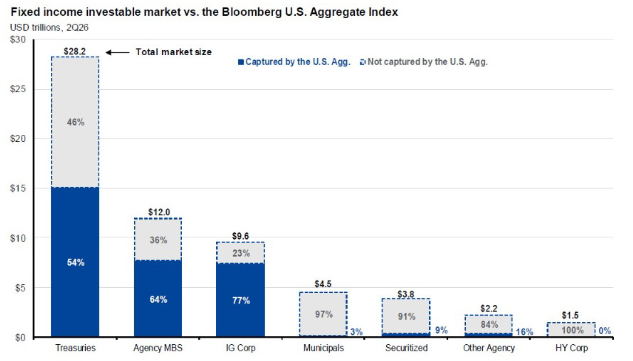
We continue to employ active management within fixed income markets. The U.S. opportunity set for credit and Treasuries is enormous, but only a small percentage of securities are included in the well-known Bloomberg U.S. Aggregate Index. 46% of the Treasury market is not included in the index, as is 91% of the securitized market. Fixed income managers have many more levers to pull when it comes to managing a fixed income portfolio relative to the benchmark. In addition to the decisions relating to duration and yield/income, credit sector exposure is crucial along with active share and security selection. Our high conviction thesis on core fixed income starts with the principal protection that the asset class provides but becomes more compelling today with higher starting yields. The same is true in municipal bonds, which saw an even greater pullback in September as issuance rose sharply but inflows softened.
Source: Bloomberg, Macrobond, Apollo